
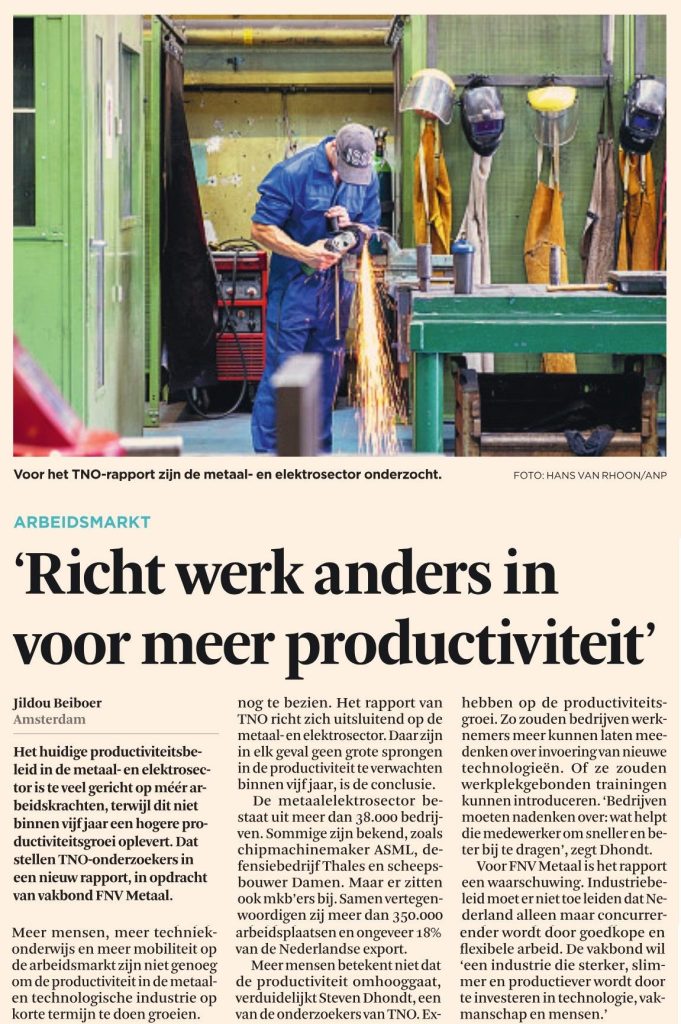
This question is at the centre of a recent study by TNO, prepared for the Dutch trade union FNV Metaal and discussed in an article published on 19 August 2026 by Het Financieele Dagblad, the Netherlands’ leading financial newspaper.
The study, involving SEISMEC partner Prof. Dr Steven Dhondt from TNO, offers a different perspective on one of the key challenges facing European industry. Instead of looking only at how to increase the number of people available for work, it asks another important question: how can companies organise work differently to become more productive?
More people alone will not solve the productivity challenge
Much of the current debate about competitiveness focuses on labour shortages. The Dutch Wennink report, like the Draghi report at European level, highlights the need to increase the supply of skilled workers.
The TNO study argues that this is only part of the solution.
As the Financieele Dagblad article explains, the Netherlands has a relatively high participation rate of the working population, but productivity growth has remained low. Steven Dhondt points out that productivity cannot be improved simply by bringing more people into the labour market. Companies also need to look at how work itself is organised.
One of the article’s central messages is captured in its headline:
“Organise work differently for greater productivity.”
Technology works better when workers are involved
The study looked at companies in the Dutch metal and electrical engineering sector. One of its findings is that businesses often invest in new technologies without changing the way work is organised.
This matters because technology alone does not automatically lead to higher productivity.
Dhondt argues in the article that employees should be involved when companies introduce new technologies. Their practical knowledge of processes and everyday work can help organisations make better decisions about how technology is designed and implemented.
The article highlights this point directly:
“Let employees think along about new technology.”
The study also points towards workplace practices such as greater employee autonomy, job rotation, workplace-based training and continuous learning as factors that can contribute to productivity.
From labour supply to workplace transformation
TNO research highlights that improving productivity requires more than increasing the number of skilled workers. Companies also need to rethink how work is organised, how technology is introduced, and how workers’ knowledge and skills are used. This human-centric approach closely reflects SEISMEC’s work to turn Industry 5.0 principles into practical solutions for more productive and people-centred workplaces.
You can read the full article in Dutch here.