
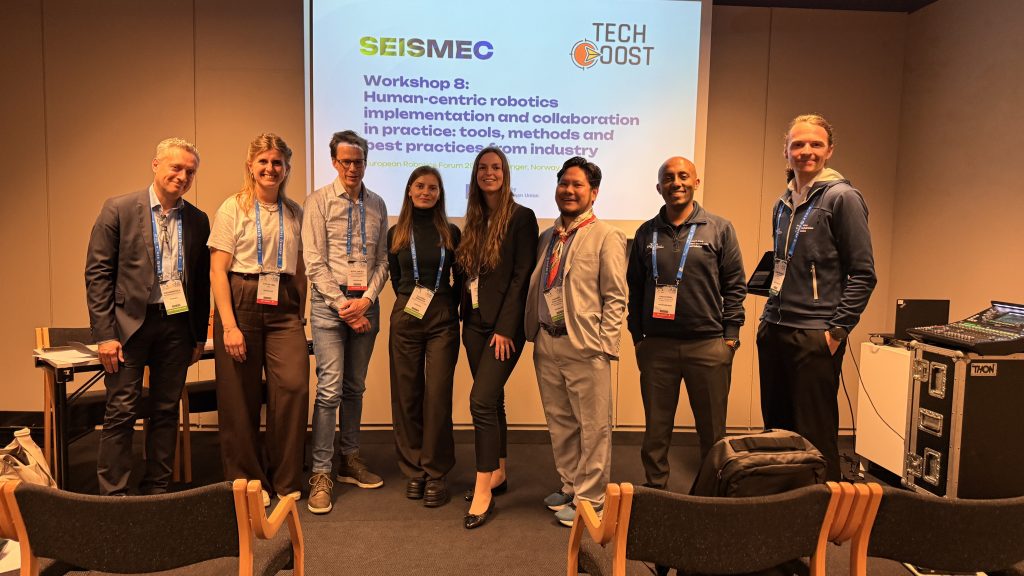
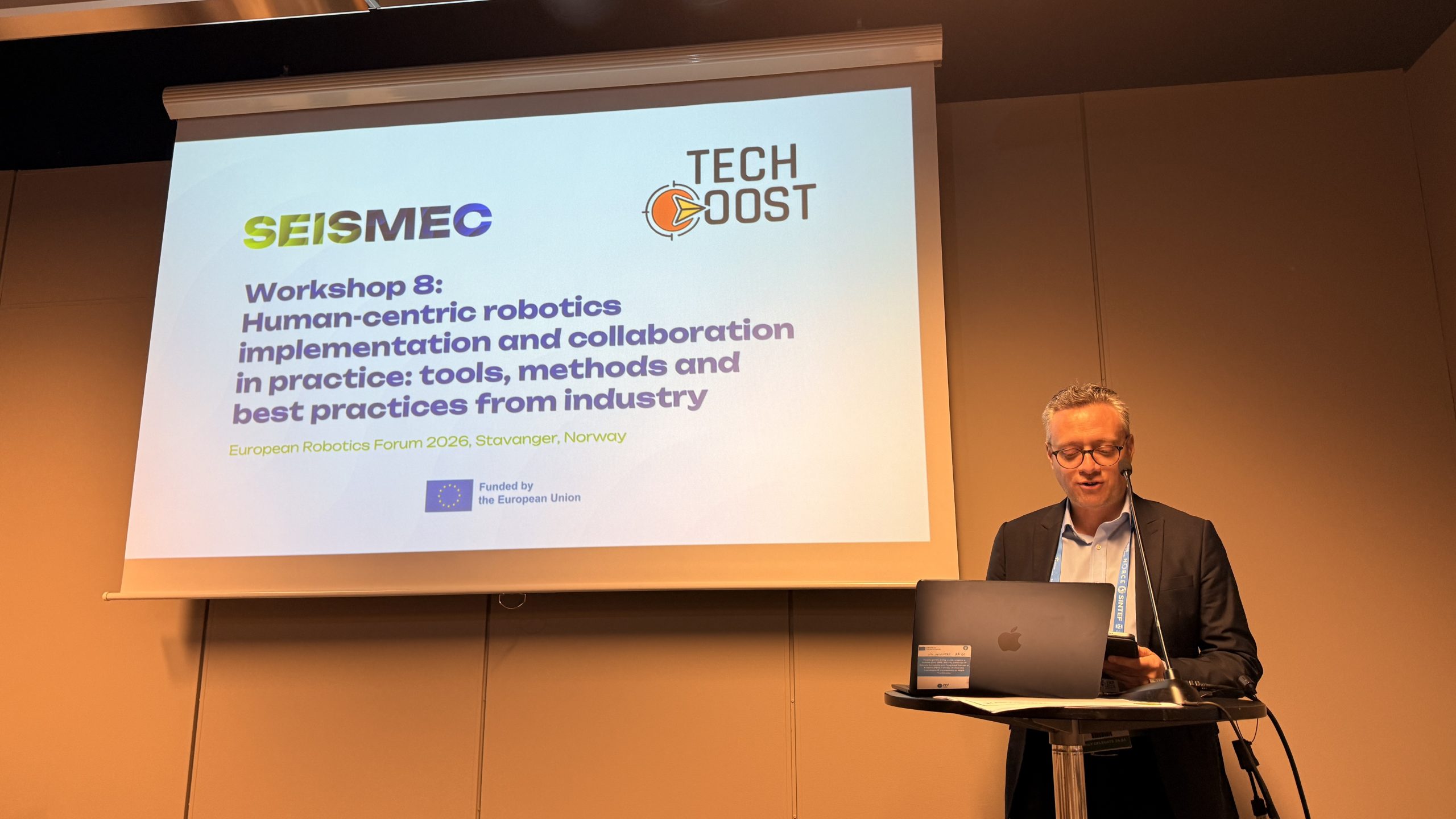
At European Robotics Forum 2026, Workshop 08 explored how human-centric approaches to robotics can be implemented in real industrial settings. The session, “Human-centric robotics implementation and collaboration in practice: tools, methods and best practices from industry”, brought together experts from Erasmus University Rotterdam and Netherlands Organisation for Applied Scientific Research working on the SEISMEC project, alongside specialists from Saxion University of Applied Sciences involved in the TechOOST Smart Implementation project.
The workshop combined three expert presentations with interactive exercises, allowing participants to engage directly with the concepts and tools presented. Across all sessions, a shared message emerged: successful robotics adoption depends not only on technology, but on how well it aligns with human needs, organisational realities, and workplace practices.
Designing Robotics Around Human Needs
The first session, delivered by TNO experts, focused on human-centric design solutions for robotics. The speakers emphasised that human-centricity should be grounded in workers’ needs, experiences, and values, particularly when organisations introduce advanced technologies.
They highlighted a set of structural tensions, referred to as CAPS factors, that organisations must navigate:
- Coordination vs collaboration
- Autonomy vs automation
- Productivity vs privacy
- Physical safety vs psychological safety
To address these tensions, a structured six-step implementation approach was presented, guiding organisations from technology identification through to evaluation of outcomes. This process places particular emphasis on worker inclusion, trust, and safety throughout the adoption journey.
The session also introduced a range of “solution directions” spanning different levels – from ecosystem approaches such as value-sensitive design, to organisational strategies like workplace innovation, and workplace-level methods including co-design and living labs. Enabling technologies such as explainable AI and digital twins were also discussed as key tools for supporting human-centric systems.
A practical example from the SEISMEC project illustrated these principles in action. In the Ateş Wind Power pilot, co-creation workshops were used to develop virtual reality training, balancing improvements in physical safety with worker autonomy and psychological safety through direct participation of operators and inspectors.
Worker Participation as a Key to Success
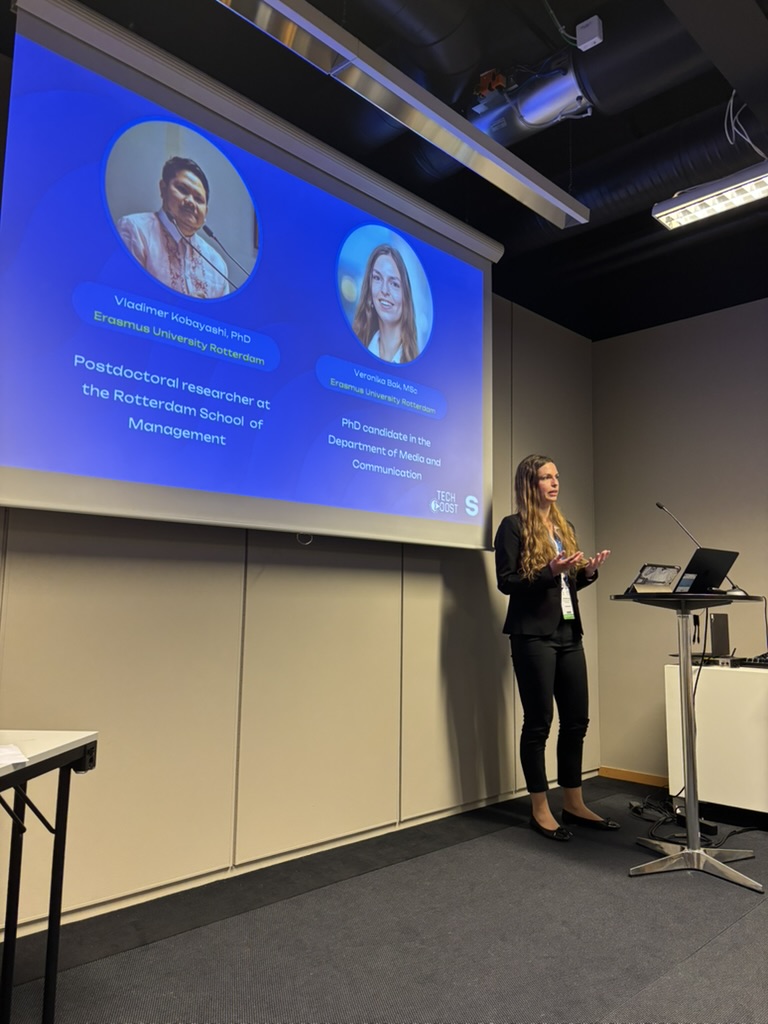 The second session, led by experts from Erasmus University Rotterdam, addressed the role of worker participation in human-robot collaboration. The discussion began with a clear challenge: automation significantly reshapes work processes, often introducing stricter rules and reduced flexibility, which can lead to strain or disengagement if not managed carefully.
The speakers argued that involving workers from the outset is essential, not to resist technological change, but to ensure that solutions reflect real working conditions and risks. Active participation was shown to improve acceptance, trust, and overall system performance, while also enhancing motivation and job satisfaction.
To support this, the session introduced the AGILE framework for worker participation. This structured approach combines four sequential steps, defining involvement models, collecting data, selecting participation modes, and applying specific methods, with seven cross-cutting considerations such as communication, training, and alignment of goals and risks.
A key takeaway was that participation must be transparent and iterative. Rather than imposing solutions, organisations should engage employees in continuous feedback loops, ensuring that technologies genuinely support their work.
Towards Integral Robotisation
The third session, delivered by Saxion University of Applied Sciences, placed human-centric robotics within a broader industrial context. Dutch manufacturers, the speakers noted, are facing multiple pressures, including labour shortages, an ageing workforce, regulatory demands, and increasing competition. In this environment, robotisation is no longer optional but a strategic necessity.
However, the session stressed that successful robotisation requires a holistic approach. Instead of optimising processes, technologies, or human factors in isolation, organisations should pursue “joint optimisation” across all three dimensions. This integrated perspective enables synergies that go beyond incremental improvements.
The proposed framework for collaborative workplace design centred on four key questions:
- What needs to be done?
- How is it currently done?
- What are the technical opportunities?
- What should interaction between humans and robots look like?
To assess outcomes, the speakers highlighted evaluation metrics such as task completion, reliability, efficiency, and worker perception. These indicators help determine whether human-robot collaboration enhances or hinders overall performance.
From Principles to Practice
Across all three sessions, the workshop demonstrated how the SEISMEC project is contributing to the practical implementation of Industry 5.0 principles. By combining human-centric design, structured worker participation, and integrated system thinking, SEISMEC provides concrete tools and methodologies for organisations navigating technological transformation.
The interactive format of the workshop reinforced the importance of dialogue and experimentation, showing that human-centric robotics is not a fixed model, but an evolving practice shaped by collaboration between researchers, industry, and workers.
Learn More
For further details and resources:
Solution directions and their design guidelines
Guidelines to Worker participation