
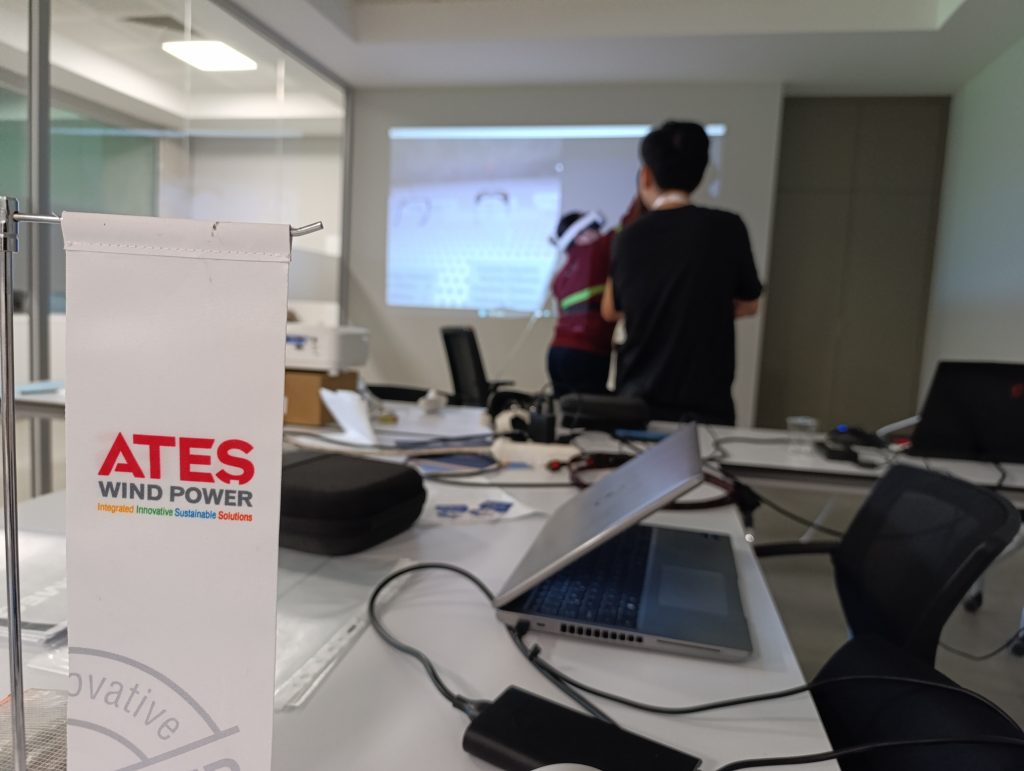
From 20 to 22 April, TNO and TUB visited ATES in Turkey to conduct measurements.
Over the course of three days, ATES employees participated in a nearly finalised welding VR training. During this training, we collected multiple types of data, including eye-tracking measurements and questionnaires on perceived usefulness and perceived ease of use of the system. In addition, we conducted semi-structured interviews focusing on spatial cognition and embodied interaction during navigation in the VR training.
In these interviews, participants reflected on phases they experienced as easy or difficult and discussed which cues helped them perform the task. For difficult phases, we explored what made these phases challenging, what sensations or feelings they experienced (e.g. frustration, disorientation, confusion, fatigue, dizziness or other symptoms), and how they responded when encountering such struggles. Furthermore, participants provided feedback on interaction and navigation within the training, reflected on differences between VR training and real-world training, and discussed the perceived usefulness of the VR training for real work applications. Open feedback was also collected.
Each day, 6 or 7 participants were measured. Most participants had welding experience and worked as operators, although there was some variation in backgrounds (e.g. an R&D engineer). In total, data were collected from 19 participants.
On the final day, we organised a workshop focusing on the impact of the change in training method on occupational safety and health (OSH) factors. The discussion addressed how VR-based training may influence OSH-related aspects of work and learning, and how these relate to relevant guidelines and standards. Due to time constraints, the questions related specifically to guidelines and standards were distributed to participants afterwards for follow-up input.
The visit provided valuable input for the continued development of the ATES pilot within SEISMEC. By involving workers directly in the assessment of the VR welding training, the activity supports a more practical understanding of how immersive technologies can be introduced in ways that improve learning, safety and usability in industrial settings.