

Recent advances in artificial intelligence have intensified discussions about the governance of digital technologies in the workplace. Alongside technical innovation, increasing attention is being given to transparency, accountability, worker participation, and the mechanisms needed to ensure meaningful human oversight throughout the implementation process.
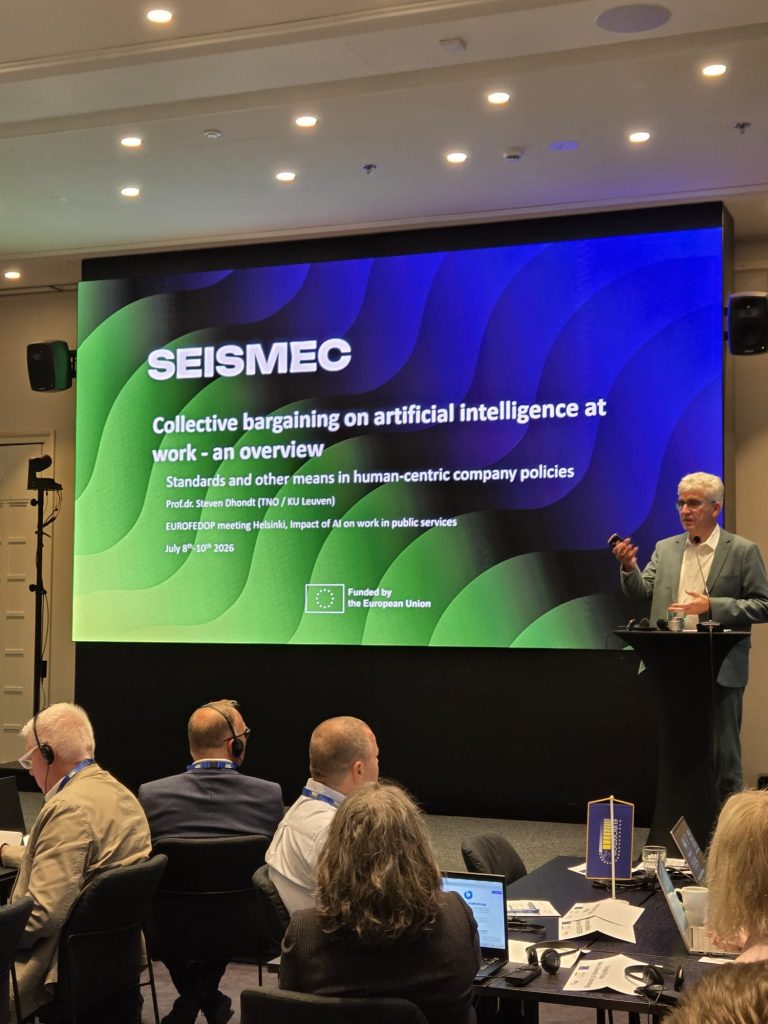
These issues were at the centre of a presentation delivered by Prof. Dr. Steven Dhondt (TNO / KU Leuven) at the EUROFEDOP meeting in Helsinki, Finland. The event brought together around 60 senior public-sector trade union representatives from across Europe to discuss the growing impact of AI on work and public services.
Broadening the debate on workplace AI
Discussions about AI often focus on learning how to use tools such as Microsoft Copilot, while digital skills are undoubtedly important, the presentation argued that this perspective is too narrow.
The more fundamental question is how organisations can ensure that workers, managers, trade unions, and technology providers jointly influence the way AI systems are introduced and used. Rather than concentrating solely on technology adoption, the discussion focused on governance, accountability, and the conditions needed for AI to support both workers and public services.
 Worker participation in AI implementation
Using examples from the SEISMEC project, including work carried out with dementia care providers, the presentation demonstrated that implementing AI is as much an organisational challenge as a technological one. Human-centred innovation requires collaboration between workers, management, technology experts, and employee representatives throughout the implementation process.
This reflects the principles of Industry 5.0, where technology is introduced to complement human expertise, improve working conditions, and strengthen organisational resilience.
Collective bargaining as a governance mechanism
One of the key messages of the presentation was that collective bargaining agreements (CBAs) can become an important instrument for governing AI in the workplace.
While legislation such as the European AI Act provides an essential regulatory framework, many practical questions remain specific to individual organisations and sectors. Collective agreements offer an opportunity to address issues such as worker participation, transparency, explainability, occupational health and safety, data protection, training, and the distribution of productivity gains generated through AI.
The presentation also reviewed examples from several European countries, illustrating how AI-related provisions are gradually finding their way into labour agreements, although implementation within public services is still at an early stage.
Human control in AI-supported work
Another important theme concerned the role of people in AI-supported decision-making.
The presentation distinguished between different levels of human involvement, ranging from reviewing AI recommendations to retaining full decision-making authority. Rather than treating “human in the loop” as a generic concept, it argued for meaningful human control, ensuring that workers remain responsible for decisions while AI serves as a tool to support professional judgement rather than replace it.