

Why existing standards need to be better connected with workplace practices to support human-centric Industry 5.0.?
European companies introducing artificial intelligence face a growing number of regulations, technical standards and ethical guidelines. Yet more guidance does not necessarily make responsible implementation easier.
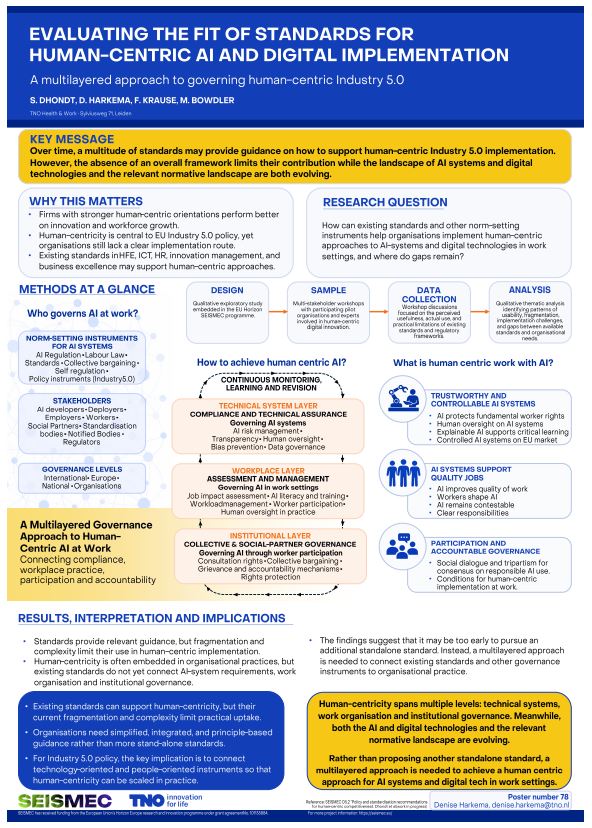
At the AI Hype, Hope & Humanity Festival 2026, S. Dhondt, Denise Harkema, F. Krause and M. Bowdler from TNO presented Evaluating the Fit of Standards for Human-Centric AI and Digital Implementation poster, highlighting their recent research outcomes.
The missing link between standards and practice
The researchers examined existing standards and governance instruments through workshops involving SEISMEC pilot organisations and experts. Their findings point to a fragmented landscape in which technical requirements, workplace practices and employee rights are often addressed separately.
To overcome this challenge, the study proposes a multilayered governance approach covering three areas:
- Technical systems: AI risk management, transparency, bias prevention and human oversight.
- Workplace organisation: job quality, workload management, employee participation and training.
- Institutional governance: workers’ rights, collective bargaining, social dialogue and accountability.
These areas need to work together. A technically compliant AI system does not necessarily guarantee good working conditions if employees have little influence over how it affects their tasks.
Better guidance instead of more standards
One of the study’s main conclusions is that introducing another standalone standard may not be the most effective solution. Organisations need simpler, integrated guidance connecting existing requirements with everyday workplace realities.
For Industry 5.0, this means considering technological reliability alongside job quality, worker participation and organisational responsibility.
The research contributes to SEISMEC’s ongoing policy and standardisation work, highlighting that human-centricity requires more than compliance: it needs practical mechanisms that protect workers’ interests and support their involvement in technological change.